Search This Blog

Showing posts with label taxation. Show all posts

2024-07-16

When Again?

[TOC: all blog posts]

Make America Great! I agree. It's already pretty great, but there is plenty to improve.

But "Again"? What does that mean? When was that era that we want to get back to? I'm not the first to ask.

Some think it refers to the 1950s. Lower-income Americans were catching up with the richer Americans back then. Assuming that's a good thing, it was indeed a good time. Coming out of the war, the working classes had some catching up to do, and catch up they did. Professor Steinhorn of American University, in an article in the Washington Post, says, "It was a time of extraordinary economic growth, with household income rising nearly 30 percent in the four years after World War II and nearly doubling during the decade."

That seems pretty good. And lower-income families gained more than higher-income ones, as shown in this graphic, cited by the Economic Opportunity Institute.
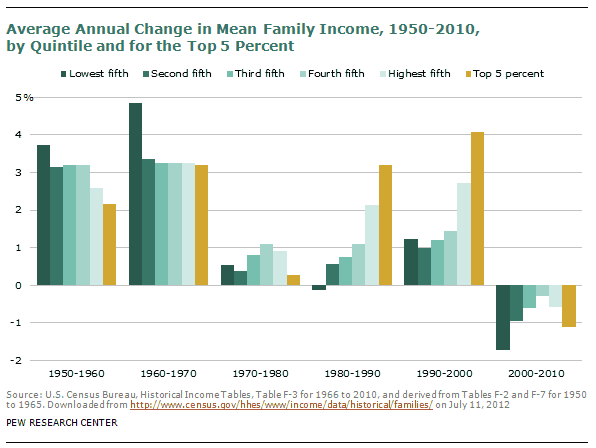
The 50s and 60s were booming. The 70s saw a slow-down, but lower-income families still outpaced the richest ones. Also in the 50s and 60s, income tax rates for the richest Americans ranged from 70% to 91%.

But what happened after that?

In the 1980s, the Reagan administration introduced trickle-down economics. The premise of this model is that the more the rich benefit, the better, because they will improve things for everyone. Among other benefits to the rich, top income tax rates dropped from 70% in 1981 to 33% in 1990. In the 1980s and 90s, the wealthiest Americans became the big winners.

The crash of 2008 pretty much eradicated income gains for all income groups in that decade, but the following decade resumed the rise of the richer folks, while the share going to lower- and middle-income families declined, as shown in these graphs from Pew Research.
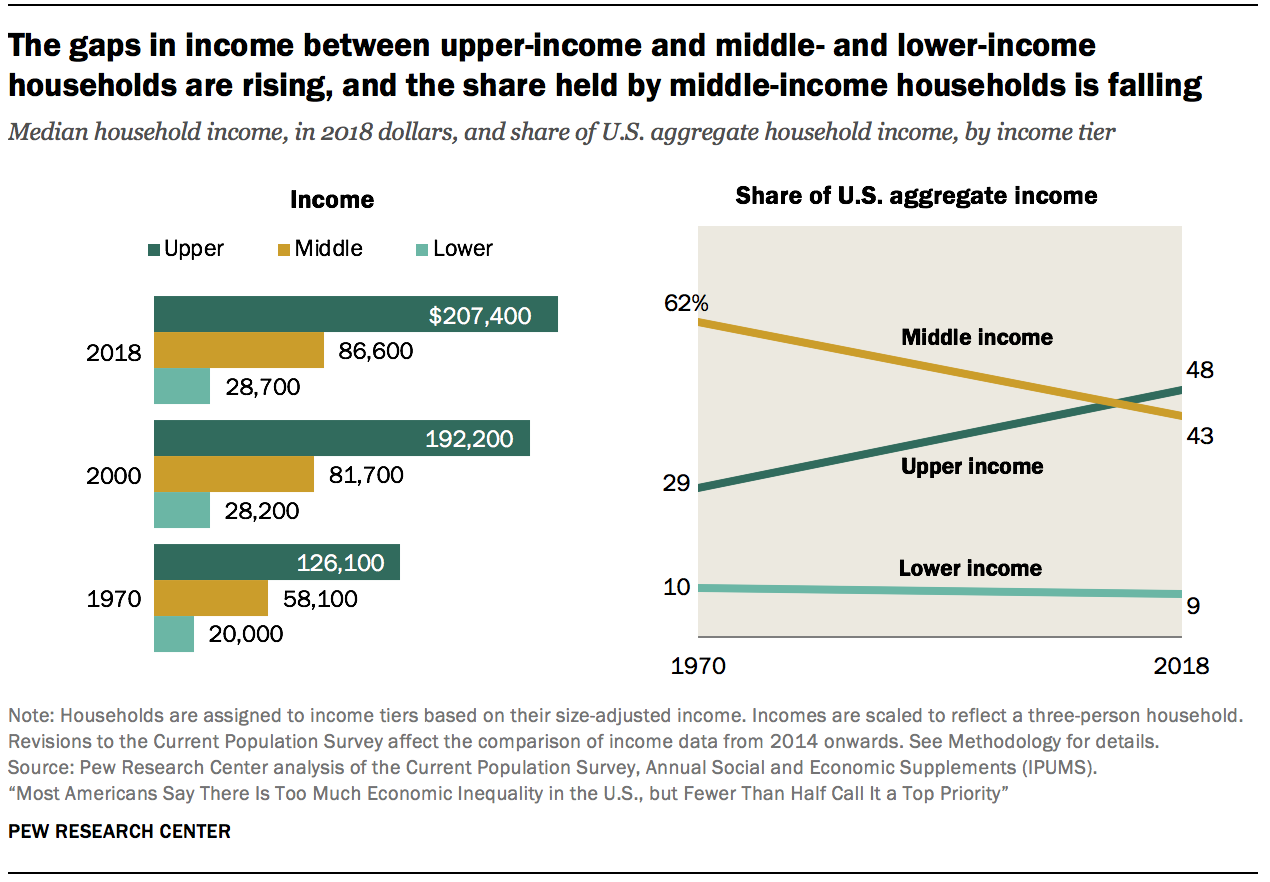
The rich did benefit, but the benefits didn't trickle down. You could say it was a failed policy (but you might not want to if you were one of the chosen few).

It is worth noting that the Clinton administration largely continued with Reaganomics. The economy boomed in the 90s and, while lower-income families did better than in the previous decade, they continued to be outpaced by the highest. This trend continued until the recession of 2008 and then picked up again in the next decade.

During the Biden administration, Congress has continued to resist tax increases for the wealthy, but the trend in income has changed back to something resembling the 50s and 60s, in part due to high levels of employment. According to a report from the Economic Policy Institute, policy drove much of this turnaround: "Faster growth for low-wage workers did not happen by luck: It was thanks to intentional policy decisions during the pandemic recession." This new trend is dramatic.
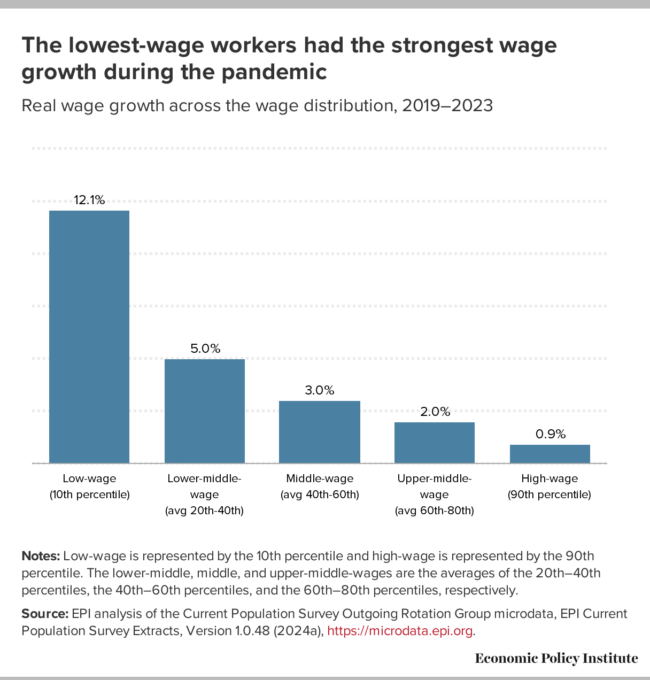
It is fair to point out that the pandemic was unique, and this trend may be short-lived. But after 40 years of watching the rich get richer while the poor lost real income under trickle-down economics, it's worth continuing this change in policy. Something is working to make America economically great again, provided you think improving the lot of ordinary folks is a good thing.

I suspect the MAGA movement is not particularly interested in improving the economy for the majority. They might be more interested in resurrecting the McCarthy purges of the 1950s.

Maybe, like J.D. Vance and Representative Grothman from Wisconsin, they just want women and certain voters back in their place.

The neo-Republican movement has support from some extremely rich people, who really hate the new trend. They may have more money than they can possibly use, but being outpaced by poor people is insulting. If lying and fear mongering gets people to vote for someone with a demonstrated track record of catering to the rich, then they will fund that campaign: no crime is worse than leveling the playing field! 

I don't know, but it seems like retrying some of the economic policies and tax brackets of the 50s could be a good thing. Elon Musk and Peter Thiel and Jeff Bezos and their ilk have had 40 years for their privileged romp. I'm tired of their whinging and tantrums.

Let's keep making America greater. We've got some traction here. Don't slip backwards.

2019-08-21

Taxation

I recently noticed a bumper sticker: Taxation is Theft. This definition of taxes would, I suppose, account for bitter opposition to taxes.

If taxation is theft, all taxes are immoral. Some of the rhetoric we hear these days would support this view: government must be limited because all it does is steal from people. That's the definition of taxation. In this view, any government tax is the equivalent to a warlord taking rice by force from subsistence farmers and villagers.

I've heard complaints about government subsidies for Amtrak. People should drive their own cars, the argument goes. But if there were no taxes, whose roads would you drive on?

Well, some taxes are OK—the ones that keep us from being incapacitated. This is known as libertarianism. Other than the essentials, any governance is illegitimate. But who decides what is essential? Is a defense budget that equals the sum of the next closest ten countries essential? How about five countries? Are all roads essential, or just some? What about national parks? Who decides what is essential? How does one get consensus?

A colleague, a few years ago, was upset with Warren Buffett for remarking that he pays a lower tax rate than his secretary. Buffet thinks that, as one of the world's richest people, his fair share should at least equal the rate his employees pay.* My colleague is as reliable and helpful as any workmate could ask for. But this perspective on taxes baffles me. On what basis would anyone be upset by Buffet's assessment? Why would his recommendation of parity be offensive?

I suppose that, if one views taxation as theft, any support of taxes must be challenged.

So, challenge me.

Taxes, in my view, are simple efficiency. I suppose that the street on my block could be paid for and maintained by the four families who live here. At the most basic level, the four of us might agree to pool our money and have the street maintained. Or maybe three families agree, and the fourth goes along or perhaps moves away in protest. If two or three of the four families on our block decided against pooling our resources, then we would each be stuck determining which section of street was ours and would have to maintain it ourselves. To pay for it, we might charge cars that pass, just as boys with shovels, hoes, and a bamboo gate charged us when we passed on the otherwise poorly maintained roads in Liberia some years ago. This does not strike me as particularly efficient or practical.

It is more efficient, of course, to maintain streets at a city level than by four-family groups; I would much rather that my street be maintained by a municipality, or the road to my farm by a county or state. Thus, taxes. If a majority of us agree on pooling our resources, I suppose the dissenters can still consider taxation as theft. But it seems rather unneighborly.

Our country was founded on anti-tax sentiments, some say: remember the Boston Tea Party (and start a libertarian political movement called the Tea Party). Actually, what colonial Americans protested was taxation without representation. The American experiment was representational democracy, not "no new taxes." If you have a vote, you are represented. You may disagree with the majority, but you have your chance to speak.

So why this wave of sentiment against taxes? Well, taxes are easy to dislike. Ben Franklin lumped them in with death as both inevitable and unpleasant.

But there's also a chance we have been hoodwinked. I notice that the ones speaking most loudly against taxes are not suggesting a reduction in our defense budget. It just so happens that some very large and influential companies make billions of dollars from our defense budget. Other lobbyists for low taxes are some (not all) of the richest Americans and American companies. They find it easy to echo Ben Franklin in disparaging taxes, and they find a willing audience among people who benefit far less from low taxes than they do. I find it curious that they find such support.

We have been told by some of these lobbyists that rich people need lower taxes because this stimulates spending and is good for the economy. But there is little evidence for this. Our economy was at its peak during the 1950s–1970s, when taxes on the richest Americans reached 70 percent and higher. I'm not saying high taxation on the wealthy necessarily leads to a better economy, but I think we have a pretty good case that it does not devastate the economy as some would have us believe. And why would one believe that extra money in the hands rich people helps the economy whereas extra money in the hands of poor people leads to irresponsibility? Is it because they haven't "earned" some of it? Well, that would be a good argument for high taxes on inheritance.

The wealthiest Americans make much of their money through capital gains, which are taxed at a lower rate than wages. So a plumber who works long hours to earn maybe $160,000 a year pays taxes at a higher percentage than the venture capitalist, who makes 100 times that much. Go figure. This is what Warren Buffet noticed, and he admitted that maybe we should rethink it.

I won't claim to understand all the ins and outs of capital gains and economics, but doesn't something seem fishy here?

Different cultures and countries might have higher tolerance for taxes than others. Right now, ours seems to have a collectively low tolerance (while we pine for the good old days of the '50s). But much of this animosity seems driven by an ideology: taxes = bad. What makes them bad? If higher taxes are what the people agree to, then it's democracy.

Don't you think democracy is more important than an ideological economic preference? I'm pretty sure the founders of our country did.

----------------------------
*An exceptional Propublica article reveals that Buffett's effective tax rate over a recent 5-year period was about 0.1% of his income. The end of the article quotes him: “There’s been class warfare going on for the last 20 years, and my class has won.”